
The dark zone's edges are the diagnosis
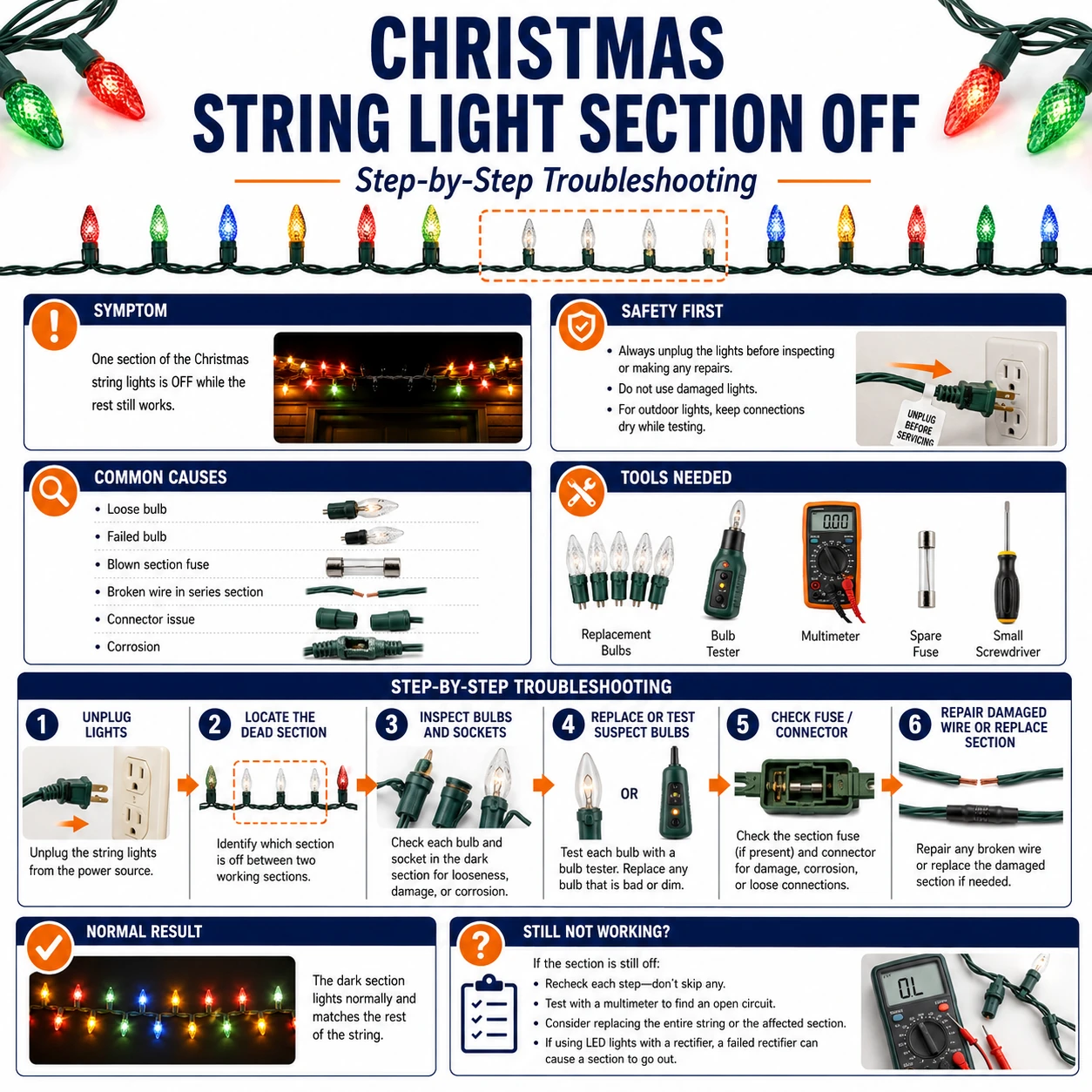
Strings are built in electrical sections: series loops where one dead bulb darkens its whole loop, parallel branches with plug-together connectors, and on curtain sets vertical drops teeing off a horizontal bus. A dark section with live neighbors means the shared element of that section broke — while the rest of the string proves the supply, controller and everything upstream innocent.
Series-wired incandescent and some LED sets add a twist: bulbs contain shunts meant to bridge a dead filament, and when a shunt fails open the whole loop dies. That is why the classic fix — pressing each bulb home in turn — works: you are hunting one bulb whose contact or shunt gave up, hidden among thirty innocent ones.
Prepare before testing
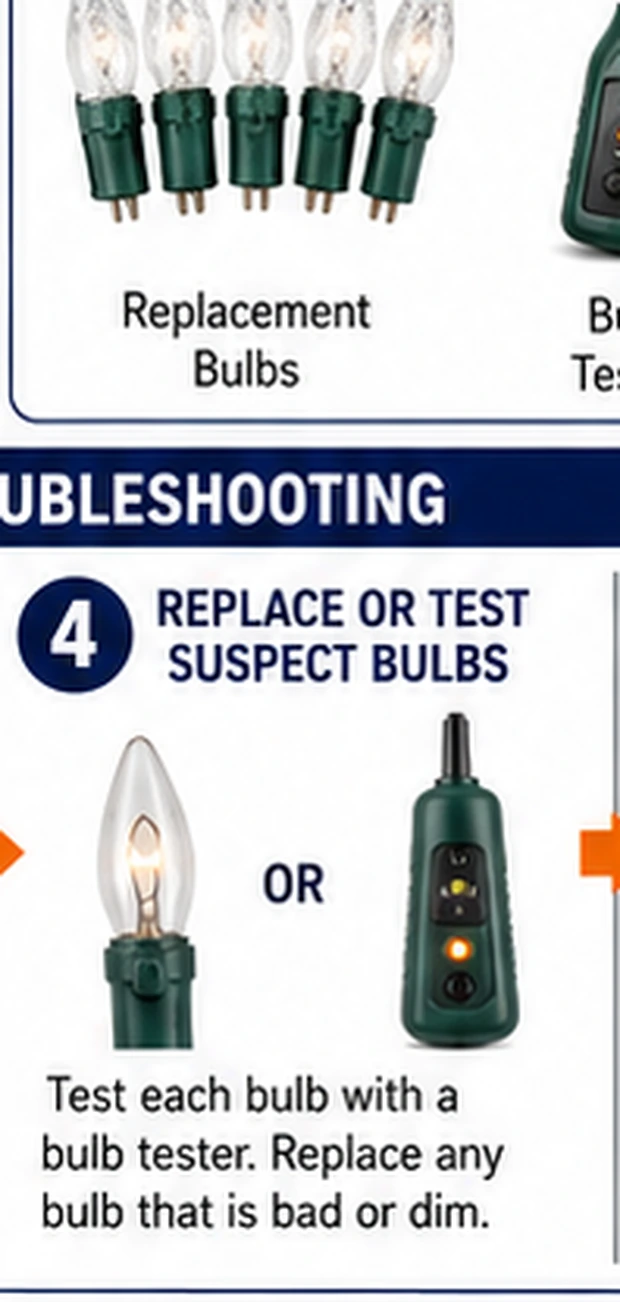
- Digital multimeter — voltage at the section's entry answers 'is power even arriving?' on low-voltage sets
- Spare bulbs of the exact type — series loops need matching voltage bulbs; one wrong spare dims the loop
- Fine sandpaper or a fiberglass pen — socket contacts oxidize green in outdoor sets
- Clothes pegs or tape for marking — mark the last-good and first-good bulbs before touching anything
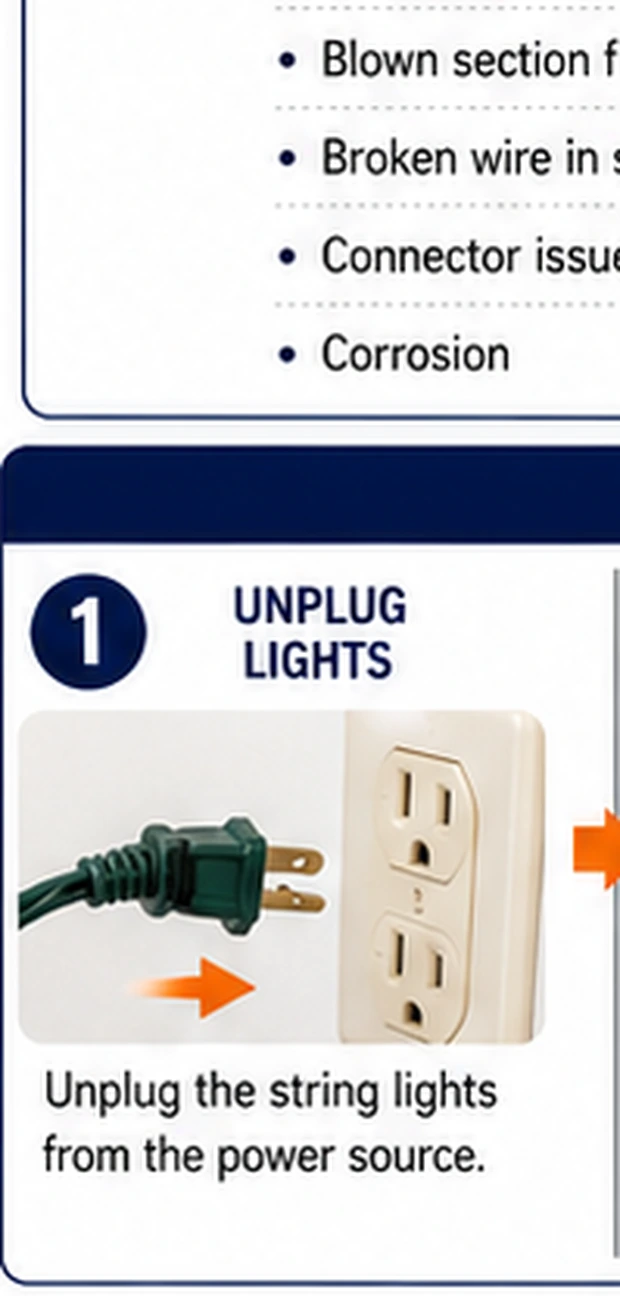
Unplug before pulling any bulb or opening any connector. On mains strings, socket cleaning is the limit of DIY — wire and socket replacement is not worth mains risk in a wet season.
Check these areas first
- One bulb's contact or shunt failed in a series loop. the whole loop goes dark for one bulb's sake
- Oxidized socket. outdoor humidity grows green oxide between bulb base and contact until current gives up
- Connector between sections not fully seated. plug-together joints work loose with wind and thermal cycling
- Stretched or broken feed wire at the section boundary. hanging tension concentrates exactly where sections join
- A curtain drop's junction failed. each vertical column tees off the bus; one bad tee darkens one column
Diagnostic procedure
Fix the boundary in your mind first, then work the shared elements of the dark zone from cheapest to most invasive: seating, sockets, connectors, feed, and only then wholesale section replacement.
Mark the exact boundaries of the dark zone
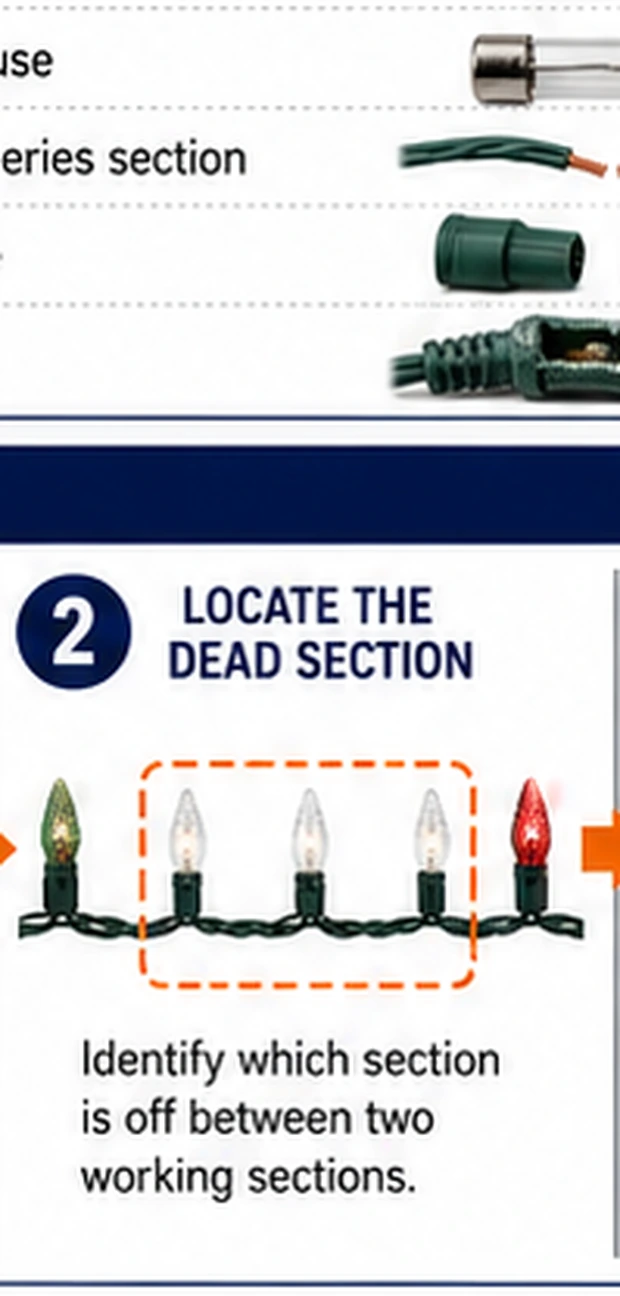
With the set running, mark the last lit bulb and the first lit bulb after the gap. Count the dark bulbs between them and note whether the zone matches a natural unit — one loop of thirty, one plug-to-plug span, one curtain column. A zone that equals a construction unit points at that unit's shared feed rather than at any bulb.
Identify the string's wiring type
Check the label and plug: mains series sets, low-voltage adapter sets, or hybrid parallel designs. Series sets die by the loop and respond to bulb-hunting; parallel sets die by the branch and respond to connector and feed checks. Thirty seconds with the label saves an hour of pressing bulbs on a set where bulbs cannot be the cause.
Check the fuse only if a whole plug-fed branch is dark
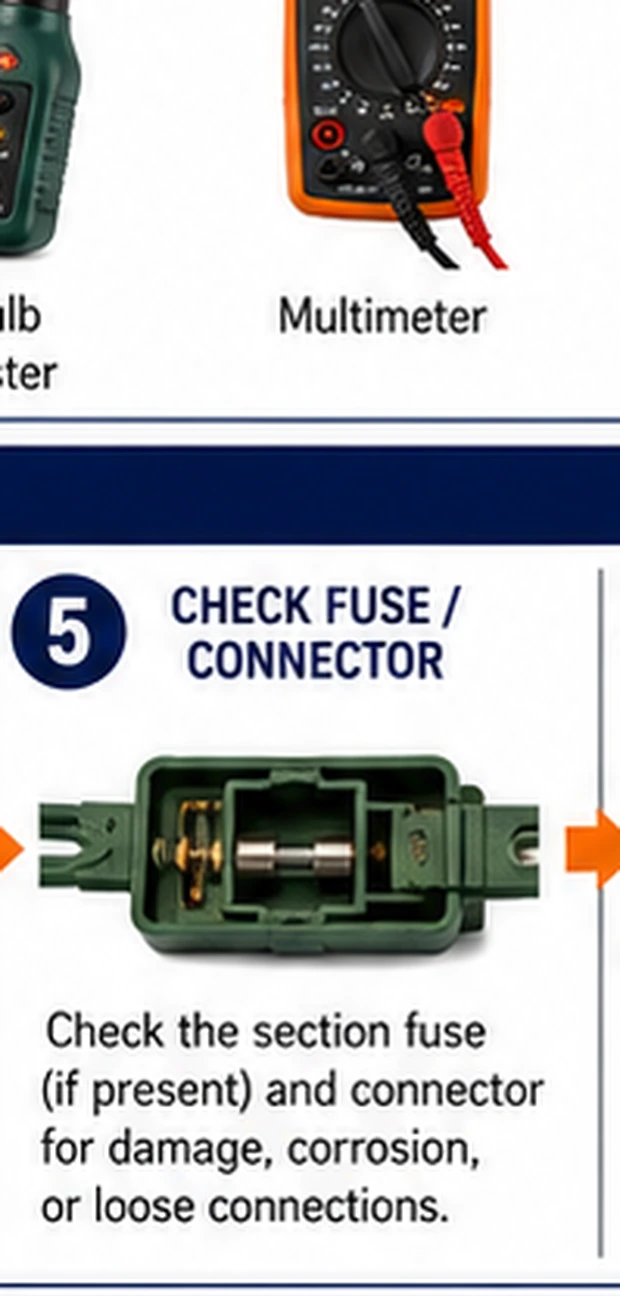
Some multi-branch sets fuse each branch in the plug or in an inline barrel. If your dark zone is everything downstream of one plug, open that fuse holder (unplugged) and continuity-test it. Same-rating replacement only — and if it blows again, the branch has a short that needs finding, not a fatter fuse.
Press and reseat each bulb in the dark loop
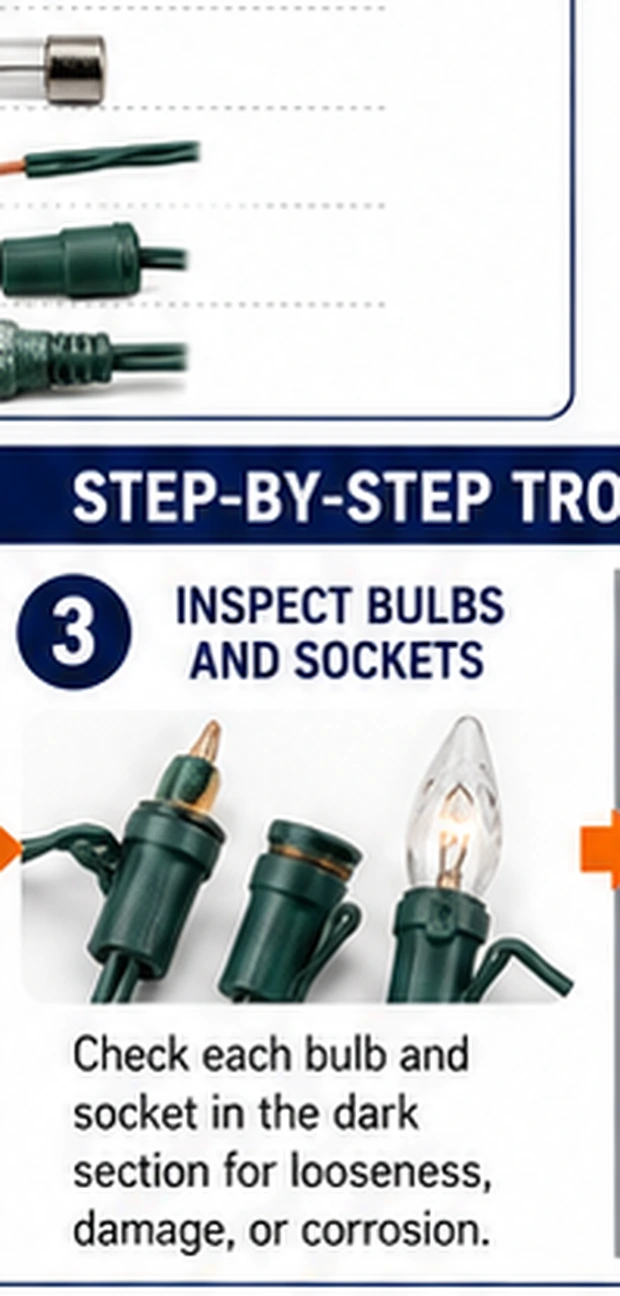
Unplugged, work the dark loop bulb by bulb: press each firmly home, and pull any suspicious one to inspect — blackened glass, a skewed base pin, or wires no longer entering the base straight. Replace obvious corpses with matching spares, then power up and see whether the loop returns before finishing the rest.
Meter the section's entry on low-voltage sets
If bulbs are innocent, unplug the section connector nearest the dark zone's start and measure incoming voltage (or on data-controlled sets, confirm the feed continues past the last good bulb). Power present at entry moves the fault inside the section; power absent moves it upstream to the previous connector or a stretched feed wire.
Replace the failed section or component
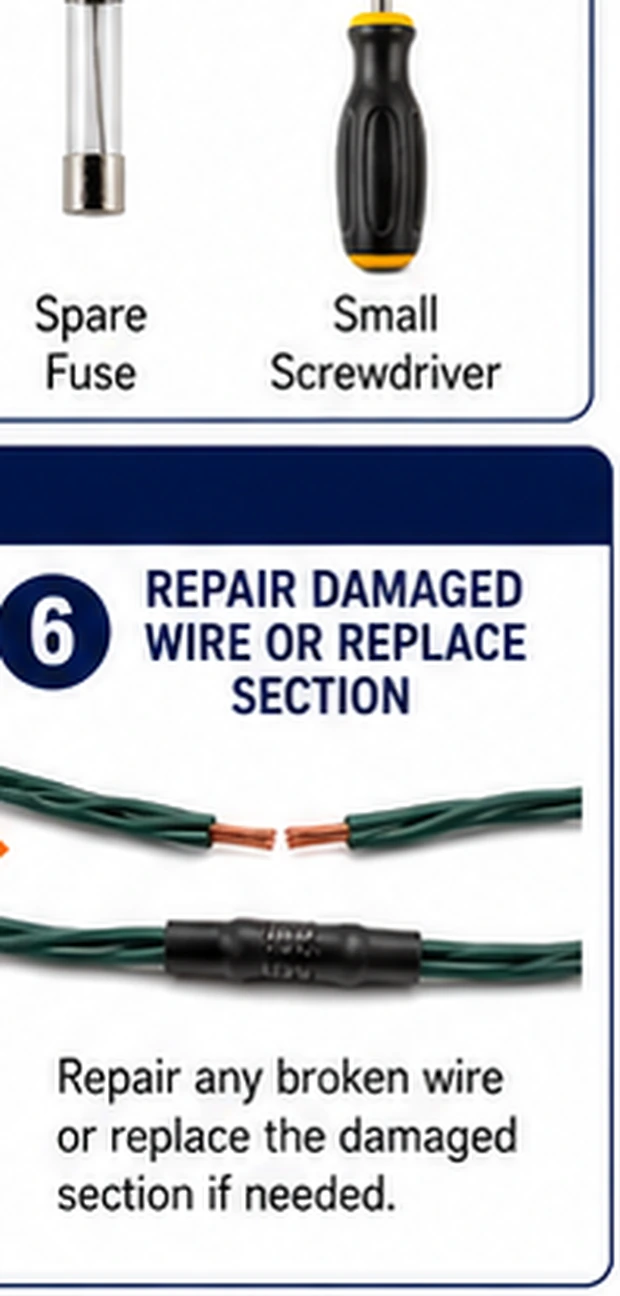
Modular sets: swap the dead section for a matching module — same voltage, same connector, same bulb count. Non-modular sets with brittle wire, burnt sockets or multiple simultaneous failures have reached end of life in that section; retire the set or shorten it at a healthy connector rather than daisy-chaining repairs down a corroding line.
When the dark zone is vertical
Curtain and icicle sets are a horizontal bus with dozens of vertical drops, and their signature fault is one dark column with lit neighbors. The column's tee junction — where the drop meets the bus — is the suspect: it takes the wind load, the drape folding, and the packing crease. Unplug, flex the tee gently and inspect for a hairline break or a pulled crimp; low-voltage drops can be continuity-tested from tee to tip in seconds. A broken drop on a modular curtain is often replaceable as a unit; on moulded sets, a soldered and heat-shrunk splice at the tee revives the column if the wire type is low-voltage. Several adjacent dark columns instead implicate the bus segment feeding them — test the bus between the last lit and first lit columns.
Packing is where sections die
Most section failures are born in January: strings yanked off gutters, wound tight around cardboard, and crushed under the decorations box. Coil loosely around a reel or forearm-width loops, pad the plugs, and store dry — a set that goes into the attic undamaged tends to come out working. Photograph the layout before takedown too; next year's hanging then reuses the same support points instead of inventing new stress lines.