
Five points share the blame, and they queue in order
Everything a dead string needs passes through a short chain: wall power (often via a timer), the plug — which on mains sets hides a tiny fuse — an adapter on low-voltage sets, the controller box with its mode button, and the first stretch of wire to the first bulb. A break anywhere upstream darkens everything downstream, which is why the whole-set-dark case is actually the easy one.
Identify your set's type before touching anything, because it decides both the danger level and the tests. A wall-wart adapter marked with a low-voltage DC output means every downstream part is safe to handle and meter. A plug that goes straight into the wall means mains runs the full length of the string — visual checks and fuse swaps only, and any wire damage retires the set.
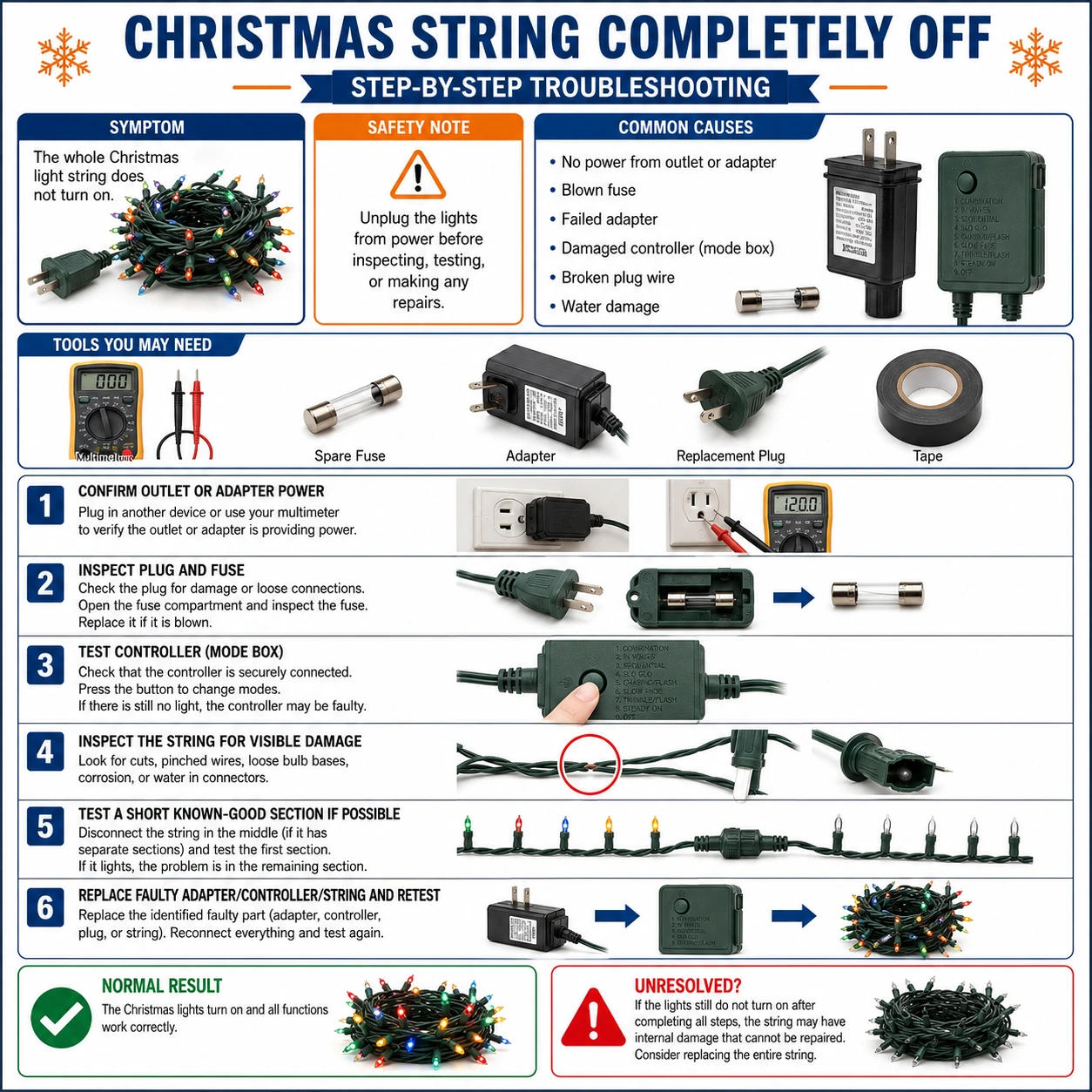
Prepare before testing
- Digital multimeter — DC volts for adapter output; continuity for the plug fuse
- Spare plug fuses of the same rating — mains string plugs hide 3 A-class micro fuses under a sliding door
- A known-working outlet or extension — prove the socket before diagnosing the string
- Small flat screwdriver — opens the plug fuse door and controller battery covers
If the set is mains-powered end to end, never open sockets or splice wire — fuse and visual checks only, and damage means replacement. Low-voltage sets past the adapter are safe to work on.
Check these areas first
- Timer or smart plug doing its job. a timer set to a stale schedule, or switched to a mode you forgot, is the leading 'fault' every season
- Blown plug fuse. mains string plugs carry a sacrificial micro fuse that dies from surge or age
- Failed wall adapter. low-voltage sets' wall-warts fail from a season in the weather or a year in the attic
- Controller box fault. corroded battery contacts, a stuck mode button, or water in the box mute the whole set
- Break in the first wire section. the stretch from controller to first bulb takes all the pulling during hanging and packing
Diagnostic procedure
Work from the wall outward. Each stage either passes power along or is the fault — and the first three stages need nothing but a spare fuse and a meter.
Prove the outlet and bypass the timer
Plug a lamp or phone charger into the exact socket the string uses. If a timer or smart plug sits in between, pull it and connect direct — or switch it to its always-on mode. Old timer schedules, tripped outdoor RCD sockets and half-dead extension reels open more December tickets than every real fault combined.

Identify the string's power type
Read the label near the plug. An adapter block with a DC output marking (for example 4.5 V, 24 V or 31 V) means a low-voltage string — meter-friendly. A bare plug on a two-core wire means mains throughout: from here your tests are the plug fuse and eyes only. This one fact routes the rest of the repair.

Check the fuse inside the plug
Unplug first. Many mains string plugs have a small sliding door hiding one or two micro fuses. Pop them out and test on continuity — a blown one often looks perfect. Replace only with the same rating (commonly 3 A); the spare pair is usually clipped inside the plug or taped to the manual.

Measure the adapter's output
Low-voltage sets: with the adapter plugged in, meter its output connector on DC volts. Healthy is within roughly ten percent of the label. Dead output, or output that collapses when the string connects, condemns the adapter — replace with one matching voltage, polarity and connector, not just whatever fits mechanically.

Reseat and exercise the controller box
Unplug, open the controller's connections, and look for bent pins, green corrosion, or a plug not fully home; battery-remote models also want fresh cells and clean contacts. Reconnect firmly, power up, and press the mode button several times slowly — some controllers wake into an 'off' memory state and need one press to show anything.

Inspect the first section of wire
Trace from controller to the first bulb, feeling for kinks, crush points and stretched sections; on low-voltage sets, continuity-test this stretch with the meter. This first meter suffers every staple and every yank. Low-voltage breaks here can be repaired with solder and heat-shrink; mains breaks retire the string.

The same logic on 5 volts
USB fairy strings compress the chain: port, cable, controller pod, string. Test the port with a phone (or the string on a phone charger you trust); many power banks also auto-sleep on tiny loads — a fairy light draws so little that the bank decides nothing is connected and shuts off after seconds, which looks exactly like a dead string. Banks with a low-current or always-on mode hold the load; otherwise a mains USB charger is the reliable home. The inline button pod is the next suspect — its micro switch corrodes — and only then the string itself, which repairs like any low-voltage set.
The seasonal economics
A fuse, adapter or timer fix costs pennies against a replacement set — always worth it. Wire damage splits by type: low-voltage strings tolerate a soldered splice happily, while mains strings are disposable by design once the insulation is compromised — no splice is worth mains in a wet garden. And if this is the second season a given set has failed differently, retire it to indoor duty and let a new set take the weather.