
LEDs make invisible leaks visible
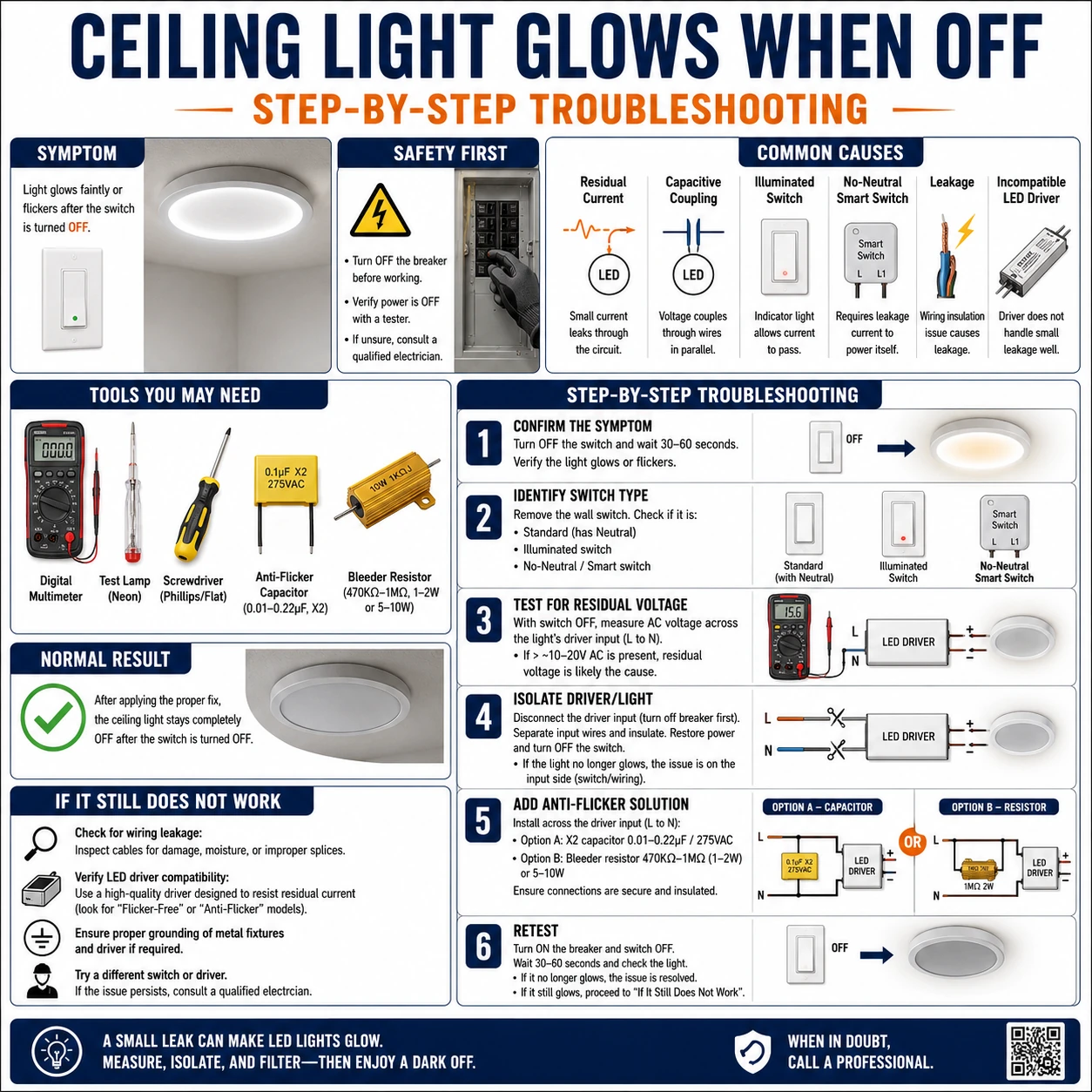
Incandescent bulbs hid this fault for decades: a few stray milliamps could never warm a filament. An LED driver, by contrast, harvests tiny currents until its capacitor fires the diodes — steadily for a continuous leak (the faint glow), or in periodic bursts as the capacitor fills and dumps (the rhythmic blink). The glow's pattern is therefore the first diagnostic: steady points at a continuous leak path, blinking at a small charging current, and rare random flashes often at switching transients or neighboring-circuit induction.
Three leak paths cover nearly every case. Illuminated switches pass their indicator's current through the lamp. No-neutral smart switches power their electronics the same way — through the load, by design. And long, bundled cable runs induce voltage capacitively between live neighbors and the switched-off wire, enough to tickle a sensitive driver. A fourth, rarer finding — the switch interrupting neutral instead of line — is a wiring fault that deserves correction for safety reasons beyond the glow.
Prepare before testing
- Observation and a note of the pattern — steady glow, periodic blink, or rare flash — the classification drives everything
- The switch's model and spec sheet — illuminated? no-neutral smart? minimum load and bypass guidance live there
- One incandescent or high-load-tolerant bulb (test only) — a classic leak-swallowing cross-check where the fixture accepts standard bulbs
- A qualified electrician — for verification of switching polarity and any bypass or rewiring work
Pattern observation and bulb swapping are homeowner territory; everything at the switch plate or ceiling rose — polarity checks, bypass modules, neutral work — is an electrician's. Treat a glow-when-off fixture as potentially live at all times: the leak proving the point is the reason.
Check these areas first
- Illuminated switch indicator. the little orange lamp completes its circuit straight through your LED driver
- No-neutral smart switch standby. the switch's own electronics sip current through the load around the clock
- Capacitive coupling on long runs. live conductors sharing a conduit induce volts on the switched-off wire
- Switch in the neutral leg. the lamp stays referenced to line permanently — a wiring fault worth fixing for its own sake
- A driver sensitive by design. some drivers fire on microamps; an identical fixture next door may stay dark on the same leak
Diagnostic procedure
Classify the pattern, identify the switch, let an electrician verify what is actually being switched, then choose the fix that matches the leak — bypass, switch change, or rewiring.
Classify the glow's pattern
Watch the switched-off fixture in full darkness for five minutes. Steady faint glow, periodic blink at a regular interval, or occasional random flash? Note also whether the behavior started after a specific change — a new switch, new bulbs, renovation on a neighboring circuit. Pattern plus history usually names the leak before any tool comes out.

Identify what the switch is
Read the wall plate and model: does the switch carry an indicator lamp? Is it a smart switch, and if so, does its documentation say no-neutral installation? An illuminated rocker or a no-neutral smart model is a designed leak source, and the diagnosis is effectively complete — the remaining question is only which cure fits.

Cross-test with a leak-tolerant bulb
Where the fixture takes standard bulbs: fit one incandescent (or one LED marketed as ghost-glow tolerant) temporarily. Glow gone means the leak is small and the cure can be as simple as one tolerant bulb per fixture or a bypass at the lamp. Glow persisting through an incandescent means a larger leak — and raises the priority of the electrician's polarity check.

Have switching polarity verified
An electrician confirms with proper testing that the switch interrupts the line conductor, not the neutral. A neutral-switched lamp glows readily, and more importantly stays line-referenced while 'off' — a shock risk during bulb changes that outranks the cosmetic complaint. This miswiring is common in old renovations and is corrected at the switch or rose.

Fit the matched cure for designed leaks
For illuminated switches: replace with a non-illuminated model, or disconnect the indicator if the design allows. For no-neutral smart switches: install the manufacturer's bypass module across the fixture (electrician-fitted), swap to a neutral-based switch where the box has a neutral, or adopt bulbs specified as compatible. Match the bypass to the switch brand — generic capacitors are not a plan.

Address induction on long runs
If polarity is correct, the switch is plain, and the glow persists: suspect capacitive coupling — typical in long conduit runs and two-way corridor circuits. The electrician's options include a bypass/compensator at the fixture and, during renovations, separating switched and live conductors. This is also the moment to accept a tolerant-driver fixture as the pragmatic cure.

Beyond the annoyance
The faint glow itself consumes next to nothing and harms mostly sleep and peace of mind. Two variants earn real priority. The periodic blink cycles the driver's capacitor endlessly and can shorten its life measurably — drivers are the mortal part of any LED fixture. And any glow traced to neutral switching is a safety finding: the fixture's 'off' is cosmetic, and the next person changing that bulb touches a line-referenced lampholder. Classify the glow honestly, and let those two variants jump the household queue.
Specifying switches and fixtures that stay dark
The glow is fully avoidable at specification time: choose non-illuminated switches for LED circuits, prefer neutral-based smart switches wherever boxes have neutrals (their standby current never touches the load), and on no-neutral installs, buy the switch brand's own bypass module in the same order as the switch. Fixture-side, drivers vary hugely in leak sensitivity — a fact rarely printed but often reported in reviews with the words 'no ghost glow'. In new wiring, asking the electrician to run neutrals to switch boxes costs little and retires this entire fault class for the house's lifetime.